
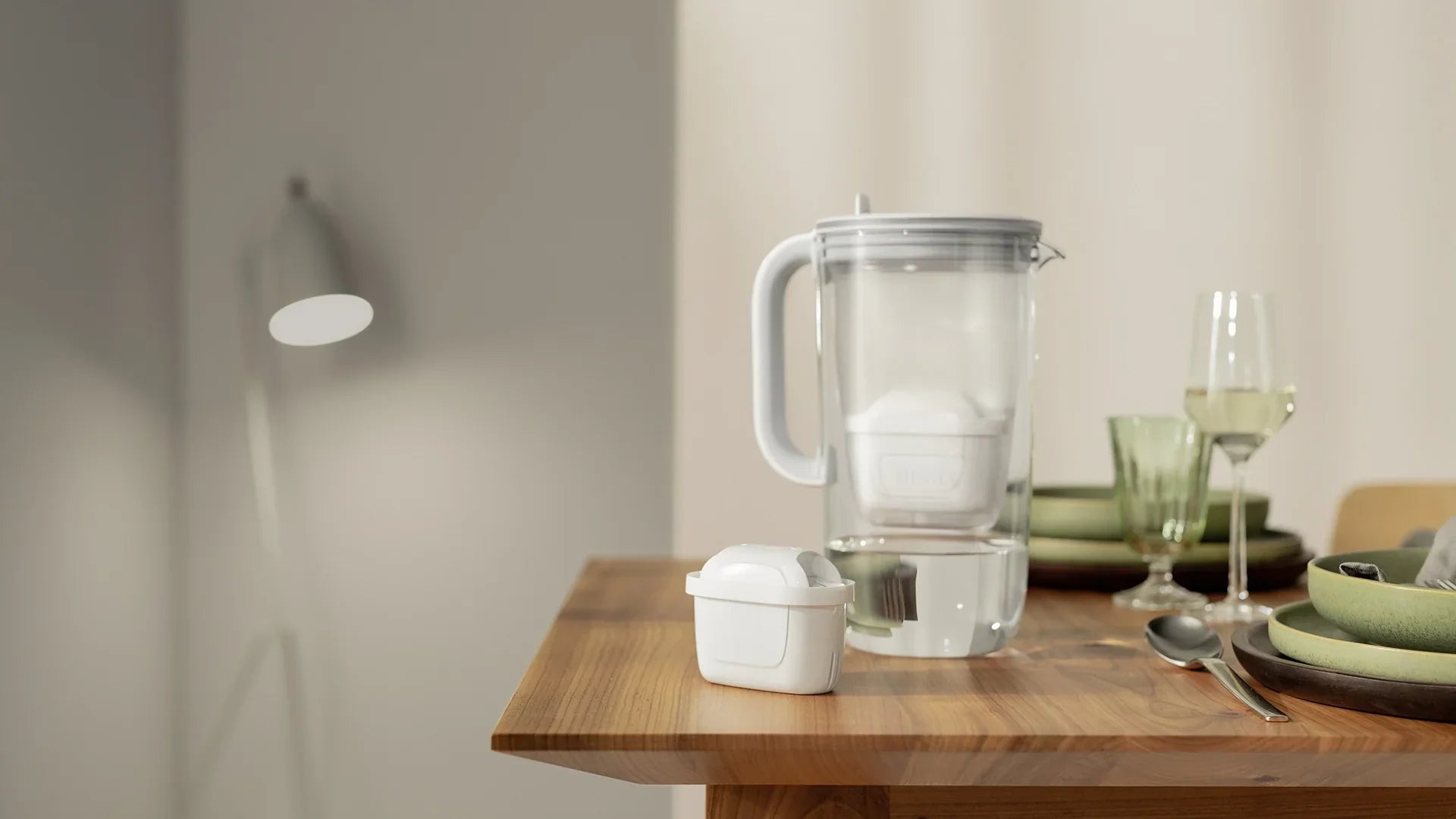
A Water Filter cartridge works with two media in sequence: activated carbon adsorbs chlorine and taste-affecting substances, and ion-exchange resin takes out part of the calcium behind limescale. Here is how each works – and, just as honestly, what a Water Filter can't do.
━━━
Inside every Water Filter cartridge, water passes through two working materials. First, activated carbon – a highly porous carbon with an enormous internal surface – captures chlorine, certain impurities and substances that affect taste and odour. Second, ion-exchange resin swaps calcium and magnesium ions for others that do not form scale. Two media, two jobs, one pass.
The carbon works by adsorption: molecules stick to its surface as water flows past, which is why a single gram of activated carbon offers a surface area measured in hundreds of square metres. The resin works by exchange: tiny beads hold loosely bound ions and trade them for the hardness minerals in the water. Neither medium adds anything – both take away, selectively.
Do water filters work? Yes – for what they are designed to do. A jug Water Filter is not a water softener (which treats a whole household's supply), not a reverse-osmosis system (which strips water far more broadly), and not a steriliser. Each technology has a different job; a jug Water Filter cartridge is built for taste, scale and everyday drinking-water quality at the kitchen counter.
The calcium that the resin removes is the same mineral that scales kettles and marks cups – why it does that, and when it matters, is covered in Is limescale bad for you?
Activated carbon: the taste medium
Charcoal or carbon? The same thing, in this context – a charcoal Water Filter uses activated carbon, usually as granular activated carbon (GAC) in jug cartridges. Activation treats the carbon with heat and steam, opening millions of pores. That porosity is the whole trick: an activated carbon water filter doesn't strain water like a sieve; it invites dissolved substances to bind to its surface and holds them there. This is also why cartridges expire – the surface fills up.
Ion exchange: the limescale medium
Ion exchange in water softening and in jug filtration follows the same principle at different scales. The resin beads carry exchangeable ions; as hard water flows through, calcium and magnesium take their place. Less dissolved calcium means less carbonate scale in the kettle – and less of the film and staining it causes elsewhere.
What do water filters remove – and what not?
BRITA Water Filter cartridges such as MAXTRA PRO PURE PERFORMANCE reduce chlorine, carbonate hardness (limescale), and certain metals such as lead and copper (if present in tap water). What they do not do: a Water Filter does not sterilise water and does not meaningfully reduce fluoride. Tap water in the UK arrives microbiologically safe; the cartridge's job is to refine it, not to disinfect it.
━━━
Sources & further reading:
United States Environmental Protection Agency (EPA)
Centers for Disease Control and Prevention (CDC)
Water Treatment Guide
Drinking Water Inspectorate (DWI) (1)
Drinking Water Inspectorate (DWI) (2)
Last reviewed: July 2026


